Selection Of Sections Of Wires And Cables
 The wires and cables shall be determined on the basis of the permissible heating, taking into account normal and accidental modes, as well as the uneven distribution of the currents between the individual lines, as heating changes the physical properties of the conductor, increasing its resistance, increasing the useless electrical energy consumed by heating the conductive parts and reducing the length of the isolation service. Excessive heating is dangerous for insulation and contact connections and can lead to fire and explosion.
Section selection cables and wires heat
 The section selection from the allowable heating conditions shall be reduced to the use of the corresponding tables of the long-sustainable Id currents for which the conductorse Lives are heated to the maximum permissible temperature established by practice in order to prevent premature isolation, to guarantee reliable contact at the connectors ' sites and to address various emergency situations observed at Id ≥ Ip, Ip is the calculated load flow.
The periodic loads of the re-time mode in the selection of the section of the cab shall be recalculated to the extended current
where Ipv is the re-time-time receiver with the length of LO.
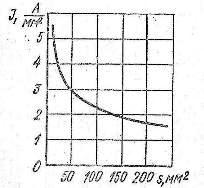
When selecting the section of the wires and cables, it should be borne in mind that, at the same heat temperature, the permissible density of the currents of the conductors living in a larger section should be lower, as the section increase is greater than the cooling surface (the cooling surface grows).Look at the rice. (1). For this reason, two or several smaller cables are selected frequently to save non-ferrous metals instead of one larger section.
Figure 1. The ratio of the permissible current density to the section of the copper lived in an openly fixed three-lay cab at a voltage of 6 kV with a paper-proof insulation heated current to +65 °C at +25 °C.
Final The selection of wiring and cables from the allowable heating conditions in the respective tables should take into account not only the design flow of the line, but also the method of laying it, the material of the guides and the ambient temperature.